
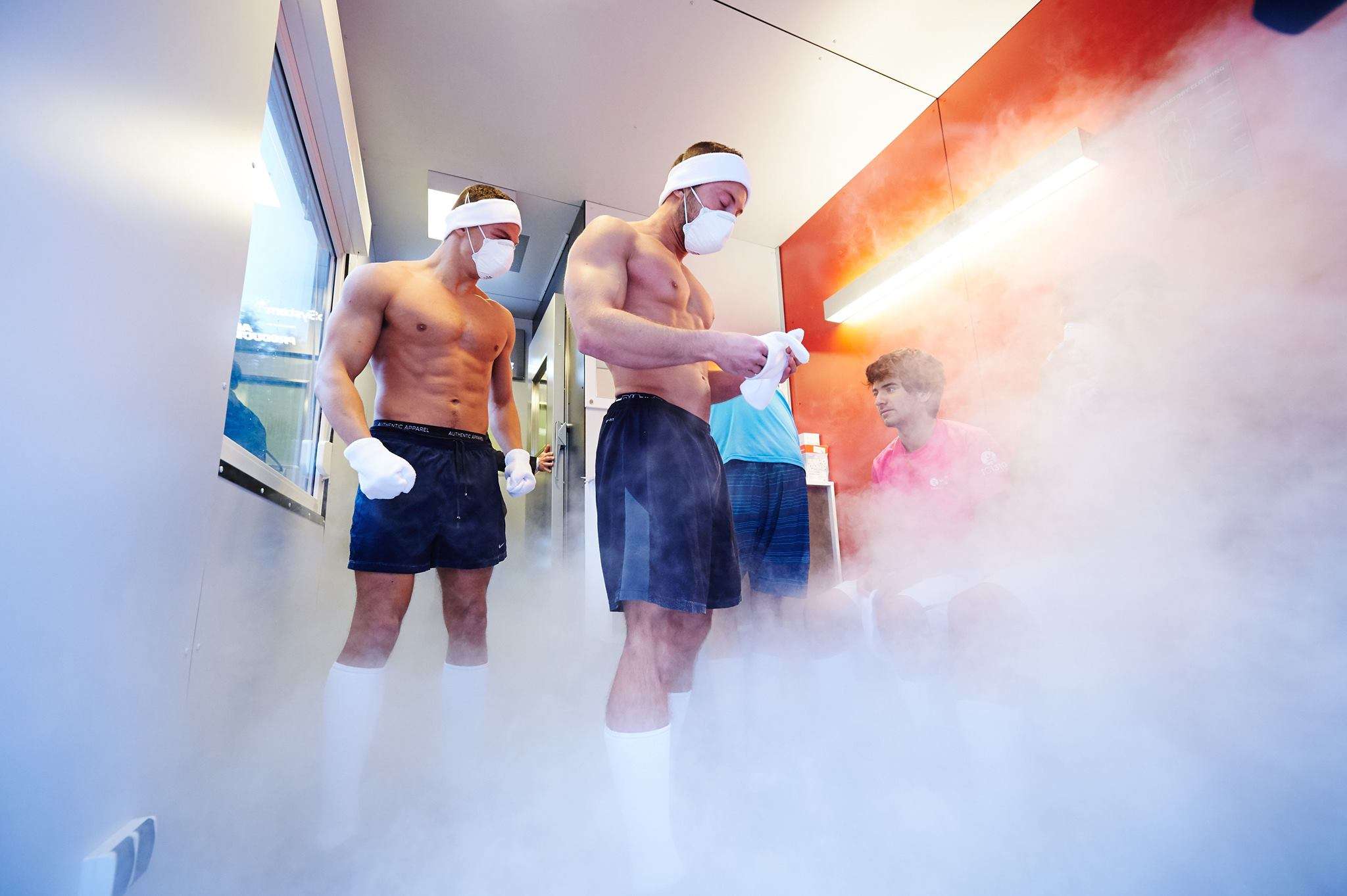
Whole-body cryotherapy at -110°C for two minutes increases muscle strength and performance
Fricke R, Grapow G, Knauer G. Steigerung von Muskelkraft und Leistung durch Ganzkörper-KälteTherapie -110°C über 2 Minuten.
Whole-body cryotherapy at -110°C for 2 showed the greatest increase in muscle strength and performance in the knee joint after 2 minutes.
METHOD:
One healthy knee joint of 7 female and 7 males were tested after a warm-up phase of 5 minutes on the CybeX ergometer. After an interval of 5 minutes, whole-body cryotherapy was carried out at -110°C for 2 minutes. Following a further pause interval of 5 minutes, the knee was tested on the CybeX. Results: the investigation of flexion 120°/s, extension 60°/s. Extension 60°/s demonstrated an increase in peak power of between 2.83% and 3.76% with the exception of extension 120°/s with a value of -3.5%. The investigation of performance yielded an increase of between 3.30% and 18.6%.
DISCUSSION:
The results of the investigations demonstrate a further increase in muscle strength and performance with a 5-minute pause before and after exposure to the cold chamber, compared to the prior investigation with a 2-minute pause. The results of investigations carried out on men and women must be evaluated separately on greater numbers of test subjects. Further investigations are required in order to work out the optimum time intervals for cold chamber application aimed at improving conditioning in sport.
SPRINTING AFTER WHOLE-BODY EXPOSURE TO COLD AT -110°C FOR 2 MINUTES
R. Fricke, K. Hoffmeister, TH. Nobbe, G. Knauer Weserlandklinik Bad Seebruck, VLOT HO
DRV-Schriften Volume 12 166-167 Prof. Reinhard Fricke Weserlandklinik Bad Seebruck, D-32602 Vlotho
The finding that, when working in cool conditions, red muscle fibres especially are activated (fast twitch = FT) more than white muscle fibres, is confirmed by tests investigating the influence of whole-body exposure on red and white muscle fibres. In an initial investigation, Esslinger noticed an increase in sprint performance (as measured by a stopwatch) in sprint tests carried out after WBCT. To confirm this observation, we measured sprint performance before and after cold-chamber exposure at -110°C for 2 minutes using an electronic measuring cabinet. In two test groups, the sprint was measured after 45m, 10m and 15m. The groups of medical students completed two sprint tests on the first day to learn the test conditions. On the following day, a cold-chamber exposure at -110°C was carried out after two new sprint tests, and 5 minutes later the sprint performances were remeasured. The two groups were separated into females and males. A further group of female physiotherapy students and one male PT student ran 3 times on the first day. On the second day, the FBCE was carried out after 3 test runs. 5 minutes later, two further test runs were measured 5 minutes apart and the mean values determined. The differences between the two groups may be due to a difference in training status. One may also assume that physiotherapy students are physically better trained than medical students. The differences between males and females are explained by the relatively greater mass of red muscle fibres in males. In the light of the investigation results, an improvement in sprint performance is observed after 10 and 15 min after cold exposure, but in the females this only occurred after 15 minutes. The differences between the two groups are due to differences in training status. There is an improvement in sprint performance in both groups, but their improvement is due to differences in training status or training level. The data show improvements in sprint performance after exposure to cold, but further standardisation of the test conditions in terms of technical requirements and the level of training is required.
Note: Some words or formatting may be approximate due to image clarity. If you’d like, I can re-run OCR on a higher-res version or provide a cleaned plain-text version.
